How Many Kitesurf Lessons to Your First Ride?
Your first kitesurf ride usually comes in 2 to 4 hours of lessons. It’s the moment you already control the kite in the air, you’ve done the body drag, and you link your first few meters standing on the board. To ride on your own with full control, most students need 10 to 15 hours.
These numbers aren’t a hard rule. They shift with where you learn, with your own pace, and with how often you take lessons. It’s worth understanding what this “first ride” really is, what stages come before it, and what makes the count go up or down.
What the first ride means in kitesurf
The first ride is the milestone that separates someone training on land from someone who’s actually riding. In practice, it’s when you master the kite in the wind window, do the body drag pulled by the kite in the water, and get your first board start, standing up and gliding a few meters.
It’s not about becoming a pro. It’s the point where the sport stops being theory and turns into feel. From there, all that’s left is repetition until you ride steadily, go out and back, and hold your line.
The stages to get there
Every serious school follows roughly the same sequence, because each step sets up the next:
- Kite control on land. You learn the wind window, how to launch and bring the kite down, and how to feel its power safely.
- Body drag in the water. Still without the board, you let the kite pull you so you understand control in the water and learn to recover the board afterward.
- Water start. The most anticipated transition, when you get your feet on the board and use the kite’s power to stand up.
- First ride. The first meters standing and gliding. This is where it clicks.
The first two or three hours usually cover land and body drag. The first ride shows up once those foundations are solid, normally between the second and fourth hour.
How many hours on average
| Milestone | Lesson hours |
|---|---|
| First ride (first board start standing) | 2 to 4 hours |
| Riding on your own with full control | 10 to 15 hours |
The first row is what almost every beginner reaches quickly. The second is what decides when you can ride without an instructor at your side. That second part is where the place you learn really moves the total number of hours.
What makes you learn faster (or slower)
Four things weigh more than the rest:
- The spot. Shallow flat water lets you train standing up, with no wave knocking you down on every try. Open sea with waves slows you down, because half the effort goes into just staying on your feet.
- Private or group lesson. One student per instructor goes much further than splitting the teacher’s attention with three other people in the water.
- Frequency. Lessons on back-to-back days lock in better than one loose hour per week. Your body holds the movement when you repeat it soon after.
- The wind. Steady wind means a lesson every day. Where the wind fails, you lose days waiting for conditions and the course drags on.
Physical fitness helps, but it counts for less than people imagine. Kitesurf is technique and wind reading, not strong arms.
Why the first ride comes faster at Ilha do Guajirú
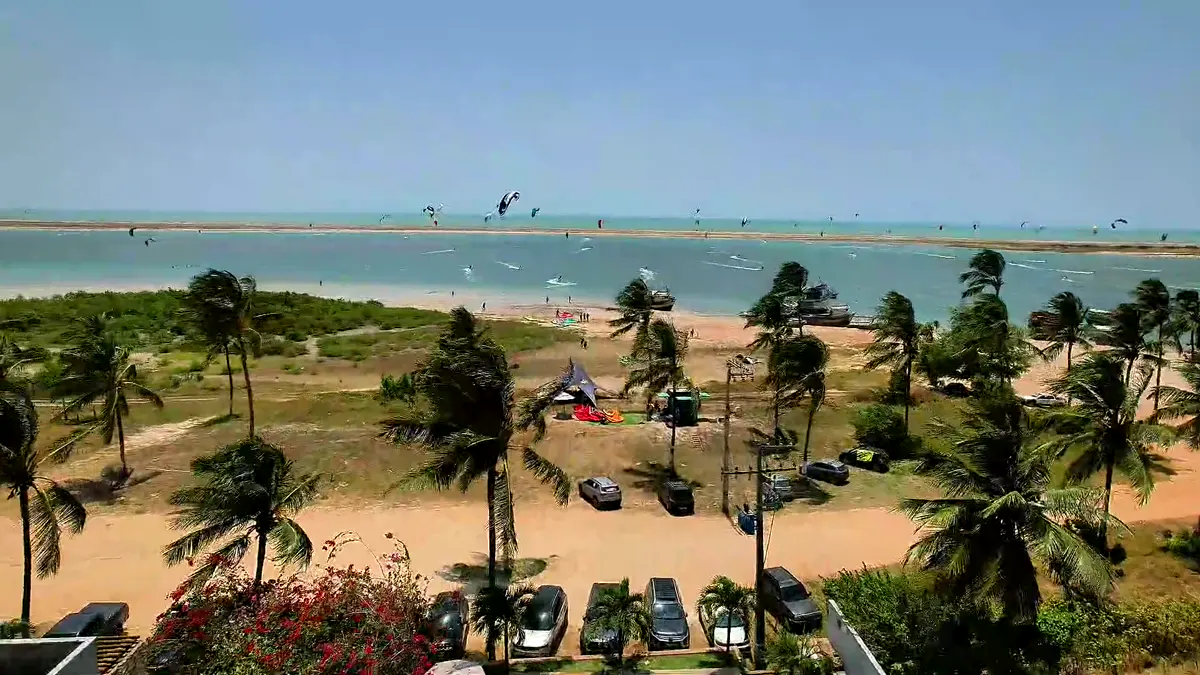
The water in the lagoon is shallow and flat, with a sandy bottom. You learn standing up, with no waves crashing and no current pulling, which makes the body drag and the water start go further per hour of lesson. Add a dedicated instructor talking to you through a radio the whole time, even at a distance, and steady wind through much of the year, and the number of hours to your first ride drops toward the lower end of the average.
It’s the kind of place where you can fit those 10 to 15 hours into a single week of travel, on back-to-back days, and go home already riding. If you want to understand the spot better, it’s worth reading the guide to the kitesurf spot at Ilha do Guajirú. And if your question is about budget, see how much a kitesurf lesson costs and how many hours go into the total.
See the packages and ask your questions
Isla Kite Center is a kitesurf school at Ilha do Guajirú, in Itarema, Ceará, Brazil, with more than ten years teaching people to ride on the flat water of the lagoon. Private lessons, Naish gear included, and a dedicated instructor from your first ride all the way to riding on your own.
Frequently asked questions
How many lessons do you need to learn kitesurf?
Your first ride, when you already control the kite and link your first few meters standing on the board, usually comes in 2 to 4 hours of lessons. To ride on your own with full control, most students need 10 to 15 hours. There's no fixed number. It depends on the spot, your own pace, and taking lessons on back-to-back days.
How long does it take to get your first ride?
On flat water with a private lesson, the first ride shows up between the second and fourth hour. That's when you control the kite safely, do the body drag, and get your first board start. On an open-sea spot with breaking waves, it usually takes longer.
Is kitesurf hard to learn?
It's not about strength, it's about technique and the right place. In the shallow flat water of Ilha do Guajirú you learn standing up, with no waves crashing, your instructor right beside you and a radio in your helmet. That shortens the curve and makes learning safer than on an open-sea spot.
Can you learn kitesurf in a week?
Yes. On a one-week trip, taking lessons on back-to-back days, you can stack up the 10 to 15 hours it takes to ride on your own. The key is frequency: a lesson every day locks in the learning better than one loose hour per week.
When is the best time to learn at Ilha do Guajirú?
The second half of the year, from July to December, when the trade winds blow steady almost every day. That's when you guarantee a lesson without depending on luck with the wind. Outside that window there are still good days, just with less certainty.